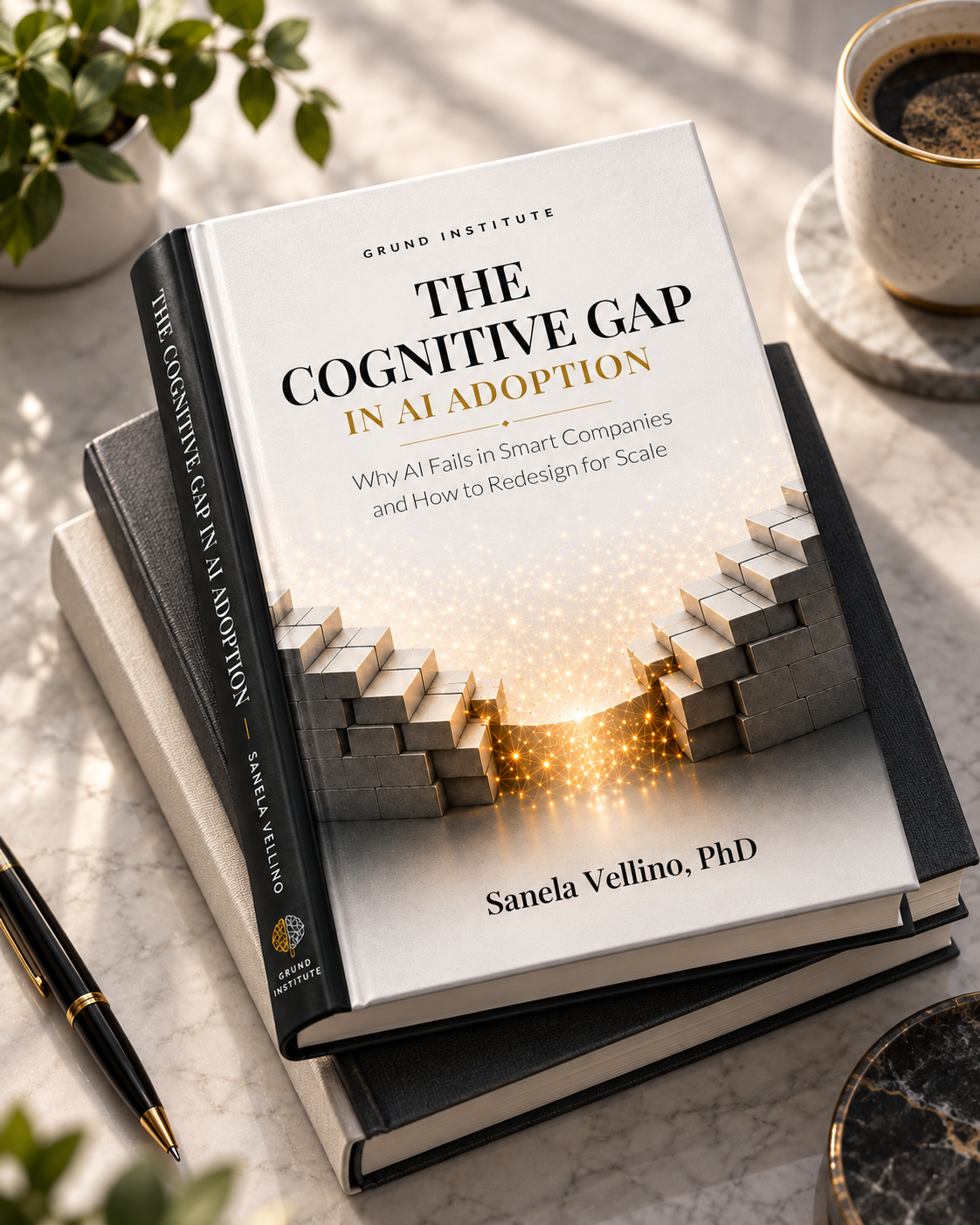
The Cognitive Gap in AI Adoption
Why AI Fails in Smart Companies and How to Redesign for Scale
Companies are investing heavily in AI, yet usage is still being mistaken for value. The problem is rarely access to the technology alone. It is the gap between how AI works, how people think, and how organizations are designed.
This book introduces a practical framework for understanding that gap and redesigning organizations so AI can create measurable business value.
AI is not the problem.
The way organizations are designed around it often is.
Generative AI is probabilistic, iterative and uncertain. Most organizations were built around predictability, standardization and control. The Cognitive Gap appears when the technology changes faster than the workflows, governance, capabilities and ways of thinking around it.
Four ideas that decide whether AI creates value.
Cognitive Fit
Why the same AI system can feel intuitive to one person and frustrating or risky to another, and why organizations should stop assuming everyone should interact with AI in the same way.
From Usage to Value
Why logins, licenses and prompt volume are weak measures of AI success, and how to focus instead on business outcomes, workflow improvement and value creation.
Organizational Design
How workflows, decision rights, governance, incentives and management practices need to change when probabilistic AI becomes part of everyday work.
Human-AI Collaboration
How people can work with AI as a cognitive extension or second mind without removing human judgment, accountability or critical thinking.
People do not work with AI in the same way.
The book explores four recurring patterns in how people engage with probabilistic AI. These are not rankings of ability or intelligence. They describe different cognitive relationships with AI and the conditions under which each can perform well.
Co-thinker
Uses AI as an active thinking partner. Comfortable exploring, iterating and developing ideas through dialogue.
Calibrator
Sees value in AI but tests, challenges and verifies its outputs before relying on them.
Controller
Works best when AI operates within clear boundaries, defined processes and strong human oversight.
AI-averse
Experiences significant friction or limited value from direct AI interaction and may perform better when AI is embedded indirectly into workflows.
No archetype is inherently better. The challenge is creating cognitive fit between the person, the task and the AI.
AI adoption is a system, not a training problem.
AI creates value only when these layers work together. Training people to use a tool cannot compensate for a workflow that should never have used AI, unclear accountability, poor business value, or a fundamental mismatch between the task and the way people need to think.
- 01Business Value FitIs there real value to capture here at all
- 02Workflow FitDoes the work itself suit probabilistic support
- 03Cognitive FitDoes the way people think match the way the AI behaves
- 04Governance & Risk FitIs accountability clear when outputs are uncertain
- 05Role & Capability FitDo roles and skills match the redesigned work
For leaders responsible for making AI actually work.
This is not a technical guide to models, tools or prompts. It is a book about the organizational conditions required for AI to create value at scale.
Built on research, not AI hype.
The book brings together research from cognitive science, organizational behavior, human-AI interaction, decision science and enterprise AI adoption, alongside the research and diagnostic work developed by Grund Institute.
Its central argument is simple: AI outcomes cannot be understood by looking at the technology alone. We also need to understand the people, workflows and organizational systems interacting with it.

About Sanela Vellino, PhD
Sanela Vellino is the founder of Grund Institute and creator of the Cognitive Fit framework. Her work focuses on the intersection of human cognition, organizational design and AI adoption, with a particular interest in understanding why the same technology produces radically different outcomes across people, teams and organizations.
Through GrundMind, she works on diagnosing where AI value is being created, lost or blocked across business value, workflows, cognition, governance and organizational capability.
AI adoption is not about getting more people to use AI.
It is about designing an organization in which AI can actually work.