01
Value Leakage Map
Where value is lost between licence, use, trust, workflow and business outcome.
Understand where AI is creating value, where value is leaking and what is blocking adoption across your workflows and teams.
“Licences are paid for, but usage is patchy and hard to explain.”
“Some teams love the tools. Others quietly stopped using them.”
“We see activity metrics, but not business impact.”
“AI output is being checked and reworked more than expected.”
“Managers and employees describe adoption very differently.”
“We do not know what to scale, fix or stop.”
Are employees actually using AI?
Is it changing the work that matters?
Where is productivity being lost?
Which workflows benefit most?
Where is AI increasing rework or risk?
What should we scale, fix or stop?
We define the decision you need to make and the teams, workflows or business areas that matter.
Employees and managers provide structured input independently through secure online surveys and targeted evidence collection.
GrundMind identifies gaps, contradictions, bottlenecks, readiness issues, perception differences and areas of value leakage.
Leadership receives a concise, prioritized diagnostic with clear actions and sequencing.
Minimal time from your team. Maximum insight for leadership.
Focused online input from the people involved. No calendar full of workshops.
A focused set of dimensions, chosen for the decision in front of you. Not a methodology tour.
Whether AI use connects to outcomes the business measures, or only to activity.
Where AI sits inside the real flow of work, and where it sits beside it.
How different people think, decide and trust when working with AI, and where that blocks use.
Whether verification, ownership and escalation work in practice.
Whether roles, skills and expectations have adjusted to the new way of working.
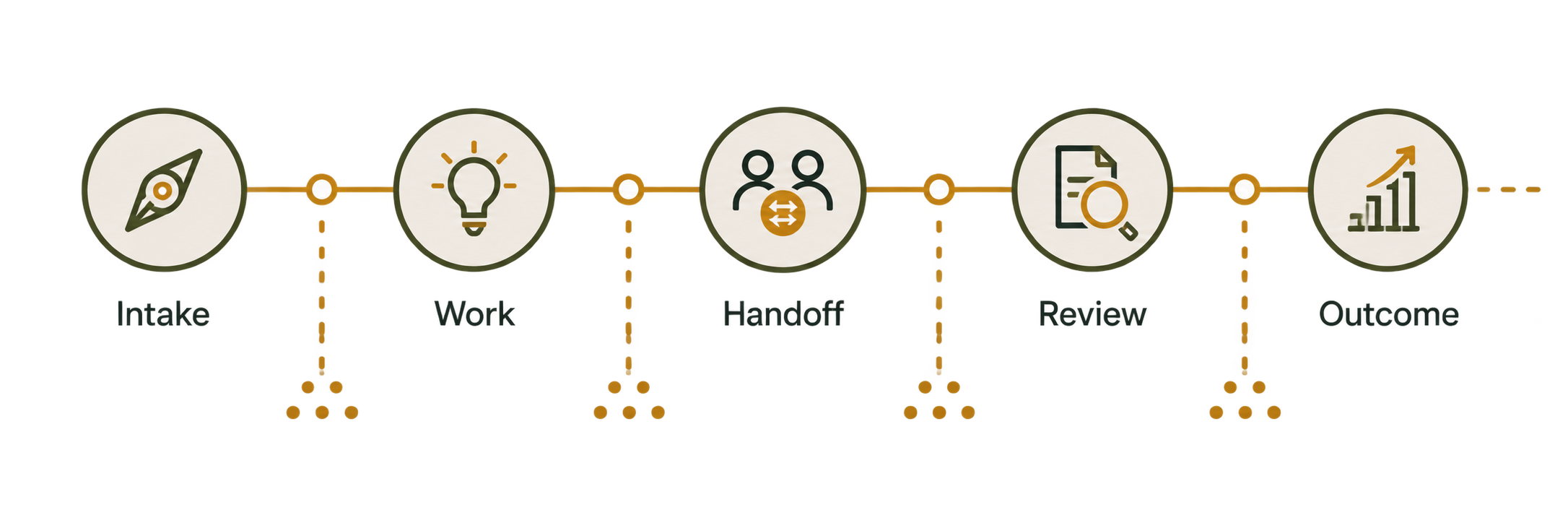
Where value is lost between licence, use, trust, workflow and business outcome.
Who is using AI, for what, and how deeply it has entered the work.
Where leadership, managers and employees see adoption differently.
What to scale, fix or stop, in order.
GrundMind turns team and workflow evidence into a practical leadership diagnosis. You see the strengths worth preserving, the barriers absorbing value, the changes that should be made, and a sequenced path forward.
Exact outputs depend on the scope and the evidence available. Missing evidence remains missing rather than being turned into a false conclusion.
GrundMind identifies where business value, workflows, Human-AI interaction, governance and capability already support useful AI work. It also surfaces the use cases that are worth pursuing rather than assuming every task needs more AI.
Barriers are kept distinct. Missing ROI, Value Leakage, Team Gap and workflow friction answer different questions, so leadership can respond to the actual constraint rather than defaulting to more training, more licences or another pilot.
Recommendations connect the evidence to concrete changes in workflow, governance, Human-AI handoffs, verification, capability and management support. The aim is not simply to increase AI use, but to make useful AI-supported work function better.
Recommended actions are translated into a 30/60/90-day roadmap with priorities, ownership, timing and measurable conditions for success. Leadership can see what to address first, what to test, and what should only be scaled once the evidence improves.
Results are delivered at the appropriate individual, team, manager and corporate level. Evidence remains attributable, privacy boundaries remain intact, and findings are reviewed before client delivery.
Our methodology is grounded in the research foundation of the Grund Institute and structured evidence, rather than generic consulting assumptions.
A focused group of experienced people works directly on the engagement. No oversized project team and no unnecessary layers.
We are designed to get the evidence we need without filling calendars with workshops.
We collect, structure, compare, analyse and synthesize the evidence. Your people provide focused input. We do the consulting work.
We compare employee, manager and workflow perspectives to expose gaps that averages hide.
Leadership receives priorities, actions and evidence, not a long slide deck with vague observations.
Evidence before intervention.
EU AI Act Readiness is relevant at every stage of the AI lifecycle. Learn more
Tell us what you are trying to decide or change. We will help you identify the right diagnostic.
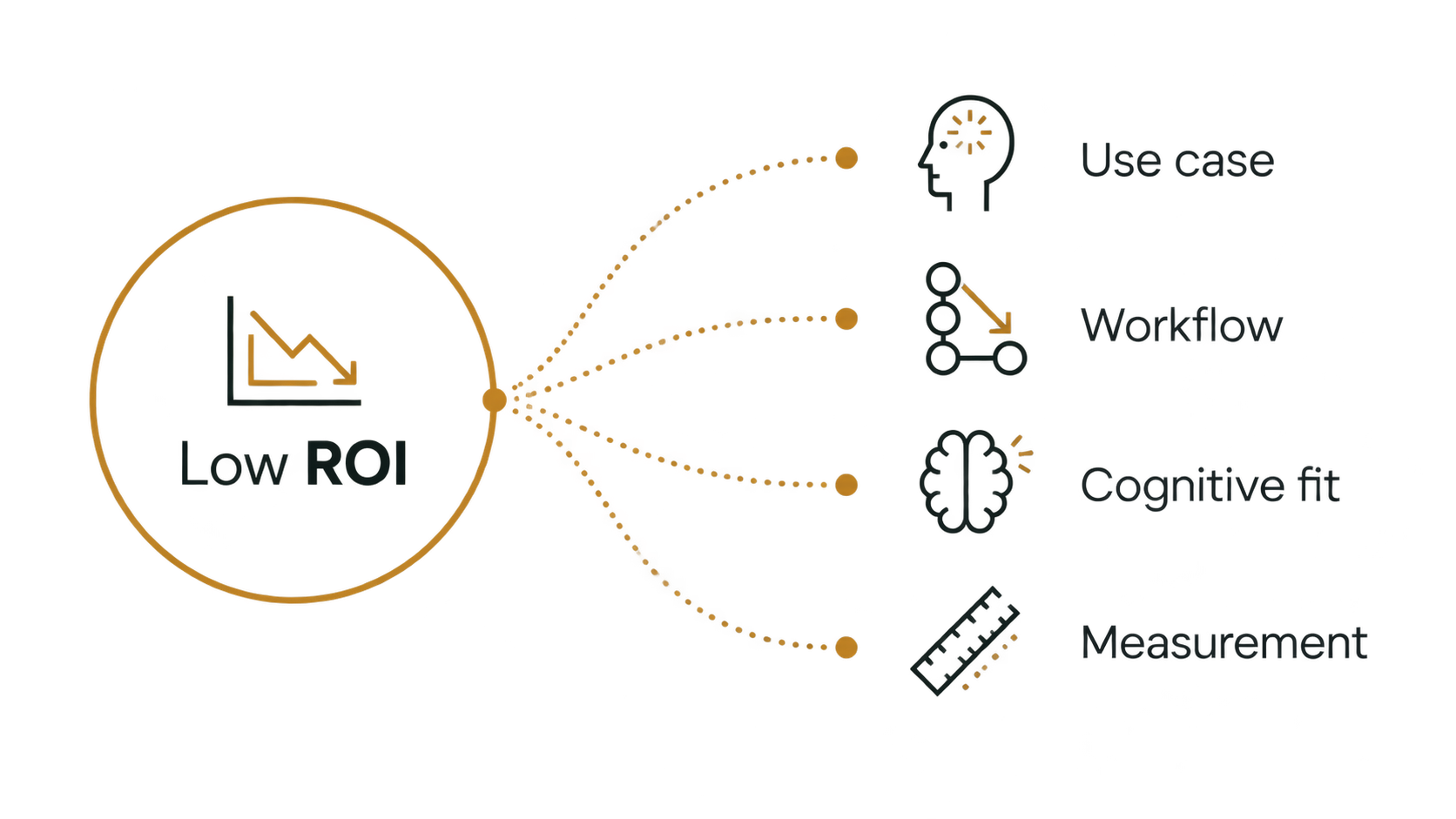
We invested in AI, why can’t we prove the return?
Where is the value actually being lost?
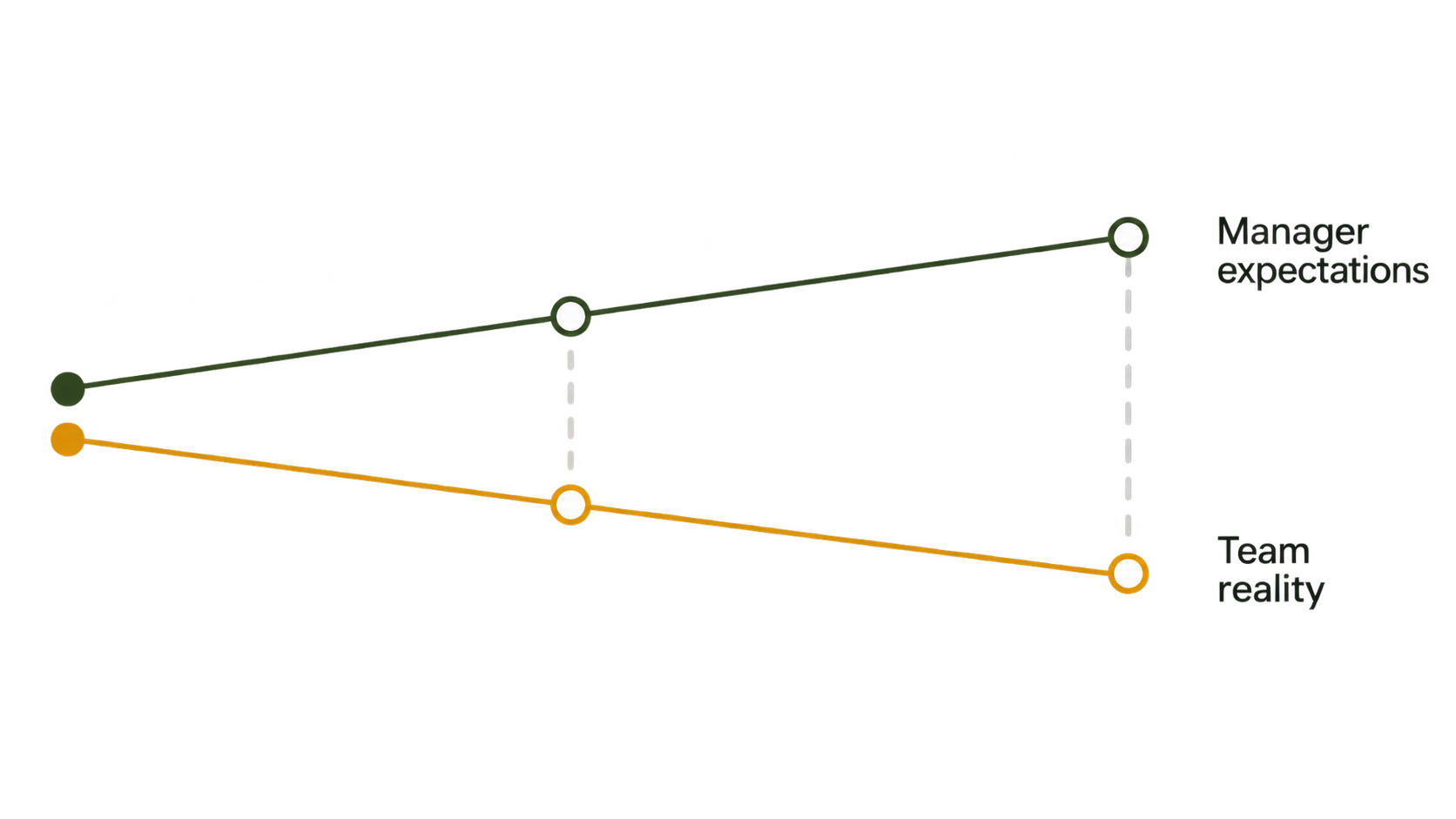
Where do leadership expectations and team reality diverge?
People use AI in different ways. Different work needs different patterns.
GrundMind separates different failure mechanisms so leadership does not respond to every AI problem with the same answer: more training, more licenses, or another pilot.
The use case, task, workflow or human-AI fit was wrong from the start.
Verification, correction, context gathering and broken handoffs eat the expected gain.
People save time, but the capacity disappears back into the same workload.
There was no baseline, KPI, ownership or measurement mechanism.
AI value is not delivered, captured or proven.
GrundMind measures extra active work created by specific AI friction using separate quantitative evidence. Value Leakage is not inferred from Fit scores and Fit ratings are never converted into time or money.
Count extra active work only, not passive waiting, baseline task time, theoretical savings, or somebody else’s time.
Extra active work spent checking, repairing or rewriting AI-supported output.
Time spent searching, copying and reconstructing information the AI or workflow lacks.
Work repeated because AI output does not survive the next handoff, review or system step.
Manager-Team Alignment compares two separate evidence sources. GrundMind shows where leadership perception and employee experience align, diverge, or lack enough evidence, without averaging the contradiction away.
When leadership diagnoses the wrong problem, it invests in the wrong solution.
A perception gap can become a value gap through misplaced training, tooling, governance or workflow interventions.
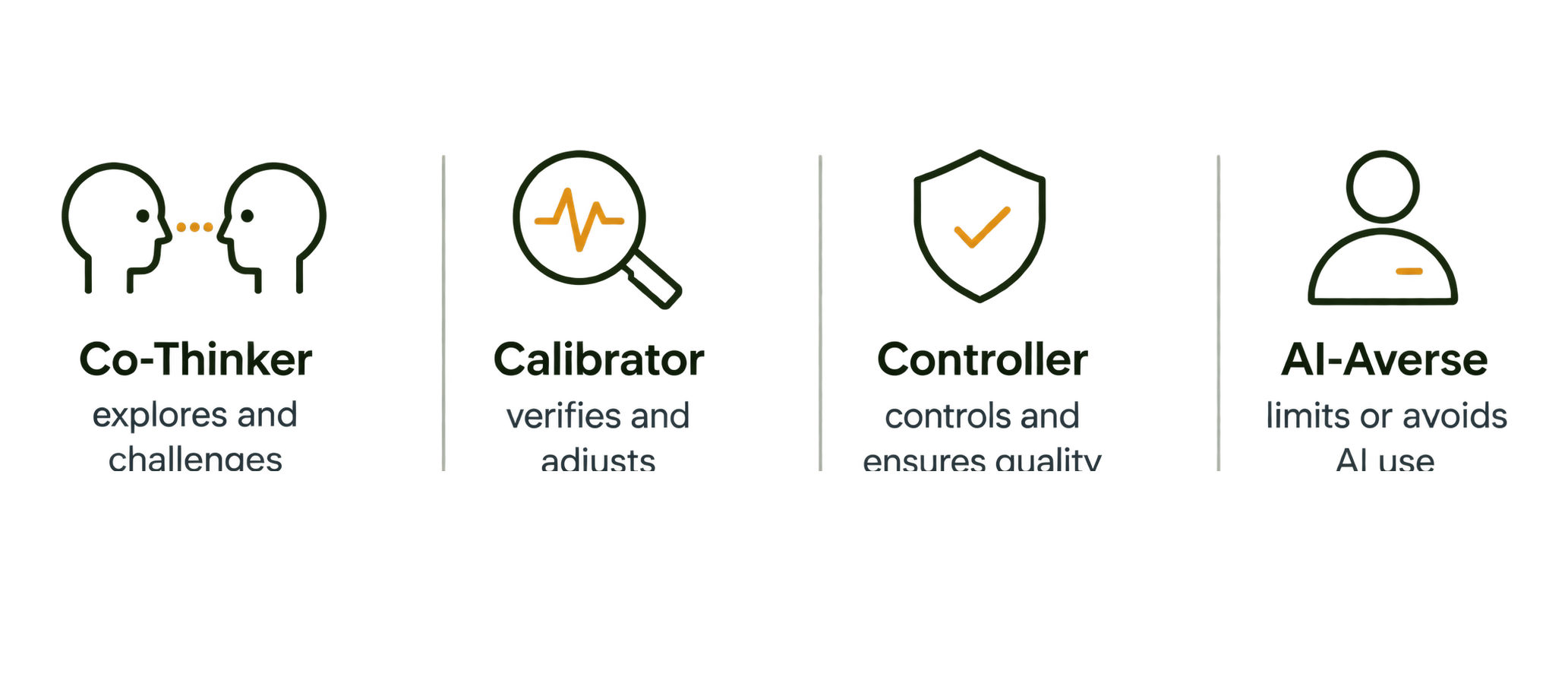
GrundMind identifies four recurring Human-AI interaction patterns. None is inherently better than another. What matters is whether the interaction pattern fits what the work requires.
Does the way people work with AI fit what the role actually requires?
Exploratory AI use may require tighter verification, auditability and control.
Iterative, exploratory interaction can create value where uncertainty is part of the work.
Low appetite for AI may be entirely appropriate if the work has little relevant AI leverage.
Illustrative role-fit logic, not normative personality ranking. Role demands, consequence of error, auditability and judgment requirements matter.
Explores broadly and uses AI as an active thought partner.
Engages confidently once evidence and verification are clear.
Works best with structure, checkpoints and clear human control.
Uses AI selectively where value, safety and certainty are proven.
Auditable conclusions you can trace back to their source.
The system is designed not to manufacture certainty. Different perspectives retain their source, evidence thresholds protect against unsupported conclusions, and insufficient evidence is shown as insufficient evidence.
Does the evidence support this conclusion?
Do the different perspectives tell the same story?
Manager evidence stays separate from team evidence.
Missing evidence is not treated as failure.
Conclusions retain the evidence source behind them.
Run a focused GrundMind pilot using employee and manager evidence, identify the real value and friction pattern, and decide what should happen before you scale.